
Why Most Organisations Will Fail at AI Adoption
Blog post description.
Geoff Bunce
3/15/20264 min read
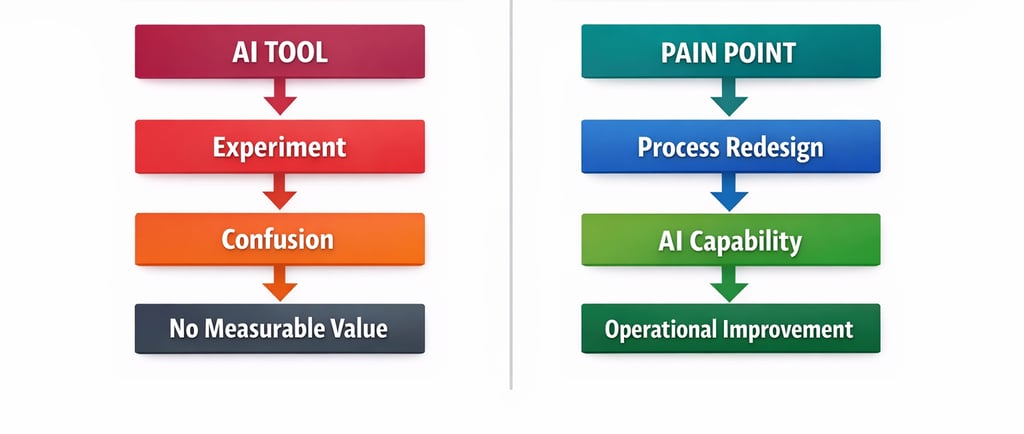
Every leadership team I encounter is asking the same question right now: what is our AI strategy? It sounds like the right question. It isn't. The right question is: where does the business hurt? The AI strategy question almost always leads organisations to start by looking at tools, which platform handles finance, which model runs marketing, which AI writes code. From that moment, the project is already drifting. The conversation becomes about capabilities, not outcomes. Teams experiment with features and hope that somewhere inside the technology, a useful application reveals itself. I've watched this play out in enterprise software environments throughout my career. The pattern is consistent. And the numbers now reflect what anyone paying attention already knew. An MIT NANDA study published in early 2026, "The GenAI Divide: State of AI in Business 2025" analysed over 300 enterprise AI initiatives and found that 95% delivered zero measurable financial return. Separately, S&P Global Market Intelligence research found that 42% of companies abandoned the majority of their AI initiatives in 2025, up from just 17% the year before. That's not a technology failure. That's an execution failure, and the root cause is almost always the same: organisations started with the tool, not the problem. The tool trap When organisations start with tools, they start thinking in categories. They look for a marketing AI, a finance AI, a software development AI. Vendors actively reinforce this framing, it suits them commercially to present AI as a department-level replacement. But businesses don't operate in neat categories. They operate through workflows. Marketing isn't a single function it's content production, campaign management, reporting, customer segmentation, performance analysis. Each of those has different constraints, different bottlenecks, different failure points. Without understanding where the real constraint is, organisations implement AI that doesn't address the underlying issue. The technology works fine. The business sees no improvement. Everyone concludes that AI is overhyped, when the actual problem is that they never defined what they were trying to fix. Pain → Process → AI Successful AI adoption follows a simple sequence. Identify the pain. Redesign the process. Then introduce AI. It sounds obvious. Most organisations don't follow it. They invert the sequence: start with AI, hope it reveals something useful, and then try to retrofit it into their operations when it doesn't. That's why the failure rates look the way they do. AI should be treated as a capability embedded within a workflow, not as the starting point for transformation. Until the operational constraint is clearly defined, AI is mostly noise. Start with where it hurts Every organisation has friction. Work that's slow, repetitive, inconsistent, or dependent on too few people. That's where AI becomes genuinely useful but only if you've clearly identified what kind of friction you're dealing with. Is the problem speed? Cost? Human capacity? Decision quality? Visibility into data? These are fundamentally different problems requiring fundamentally different solutions. Confuse them, and you end up solving the wrong one or worse, building something sophisticated that solves a problem that doesn't actually matter. Once the pain is clearly defined, the next step is to map the workflow that produces it. What steps are involved? Where does information come from? Where do decisions occur? Where does human judgement actually matter versus where is it just habit? Only once that's understood can you determine where automation or augmentation helps. This is where most AI projects actually fail. Instead of redesigning the workflow, organisations insert AI into existing processes and hope the output improves. It rarely does. AI doesn't fix broken systems - it amplifies them. Same label, different problem Consider two companies that both say they need marketing AI. The first company has no dedicated marketing team. The founder is handling everything personally. Content doesn't get produced consistently because there isn't capacity to produce it. The pain is production volume. An AI system that generates copy, social posts, ad creatives, and campaign assets fed with product images, offers, and basic direction could meaningfully increase output. Here, AI is solving a clear operational constraint. The second company already has a marketing team producing campaigns. The problem is that leadership has no visibility into what's working. Reports exist but nobody fully understands them or knows what actions to take. The pain is decision insight, not content volume. Deploying a content generation tool in the second company solves nothing. It produces more of something they already have too much of. What they need is an AI that interprets campaign performance, identifies patterns, and surfaces actionable insight. Same label, marketing AI. Completely different problems. The tool that works for one fails entirely in the other. This is not a hypothetical scenario. I see versions of this constantly. The organisations that will get this right The companies that succeed with AI won't be the ones buying the most tools or moving the fastest. They'll be the ones thinking more carefully about their operations identifying specific constraints, redesigning processes around those constraints, and then using AI to support the new workflow. The MIT research points to the same pattern. The organisations reporting measurable returns didn't start with AI. They started with a clearly defined business problem, quantified the cost of that problem, and only then built a solution around it. Lumen Technologies is an example: their sales team spent four hours researching customer backgrounds before each call. The company quantified that as a $50 million annual drag, then built an AI solution to compress that research to 15 minutes. The result was measurable, immediate, and fundable. That's the approach. Define the pain. Quantify it if you can. Redesign the process. Then apply AI. The actual AI strategy Artificial intelligence is not a department in a box. It's a capability that amplifies well-designed processes and just as effectively amplifies poorly-designed ones. If you're trying to define your organisation's AI strategy, start with a simpler question: where does the business hurt? Once that's clearly defined, the path forward becomes much more obvious and the risk of becoming another abandoned project on the S&P Global spreadsheet drops considerably. Pain → Process → AI. The organisations that remember that sequence will build something durable. The rest will accumulate expensive tools and wonder why nothing changed.
Geoff Bunce
Geoff Bunce is an operator and builder with 10+ years in smart ticketing technology. Founder of Bunce Group: the parent company behind Fidelis News, Dog and Outdoors, and Rook6 Lab. Head of Solutions at Paragon ID. Writing, building, and documenting the journey at geoff.buncegroup.com.
DOg and outdoors ltd
© 2026. All rights reserved.